You quote over WhatsApp, keep invoices in a spreadsheet, and at the end of the month you scroll back through chats to work out who has paid. Quotebook keeps the whole trail in one place: quoted, accepted, invoiced, paid. It's a demo I built for this portfolio, not a product with paying customers.
Quotebook: From quote to paid in one link
Quotes, invoices and payments for small service businesses. Customers accept a quote from a link, and one screen shows who still owes you.
Try the demo (opens in new tab)
No sign-up. It's a sample photography studio that resets every 6 hours. The first load can take up to a minute.

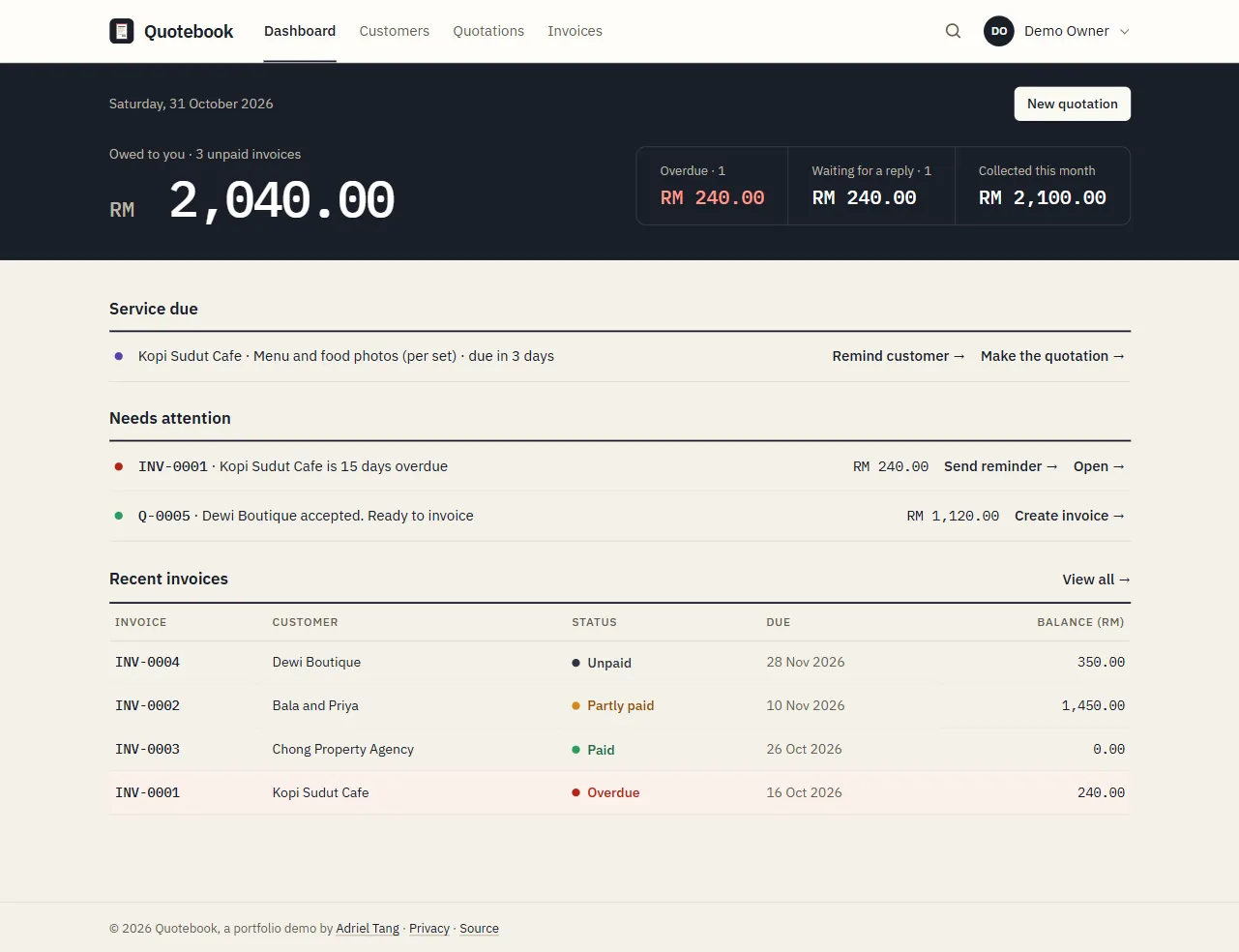
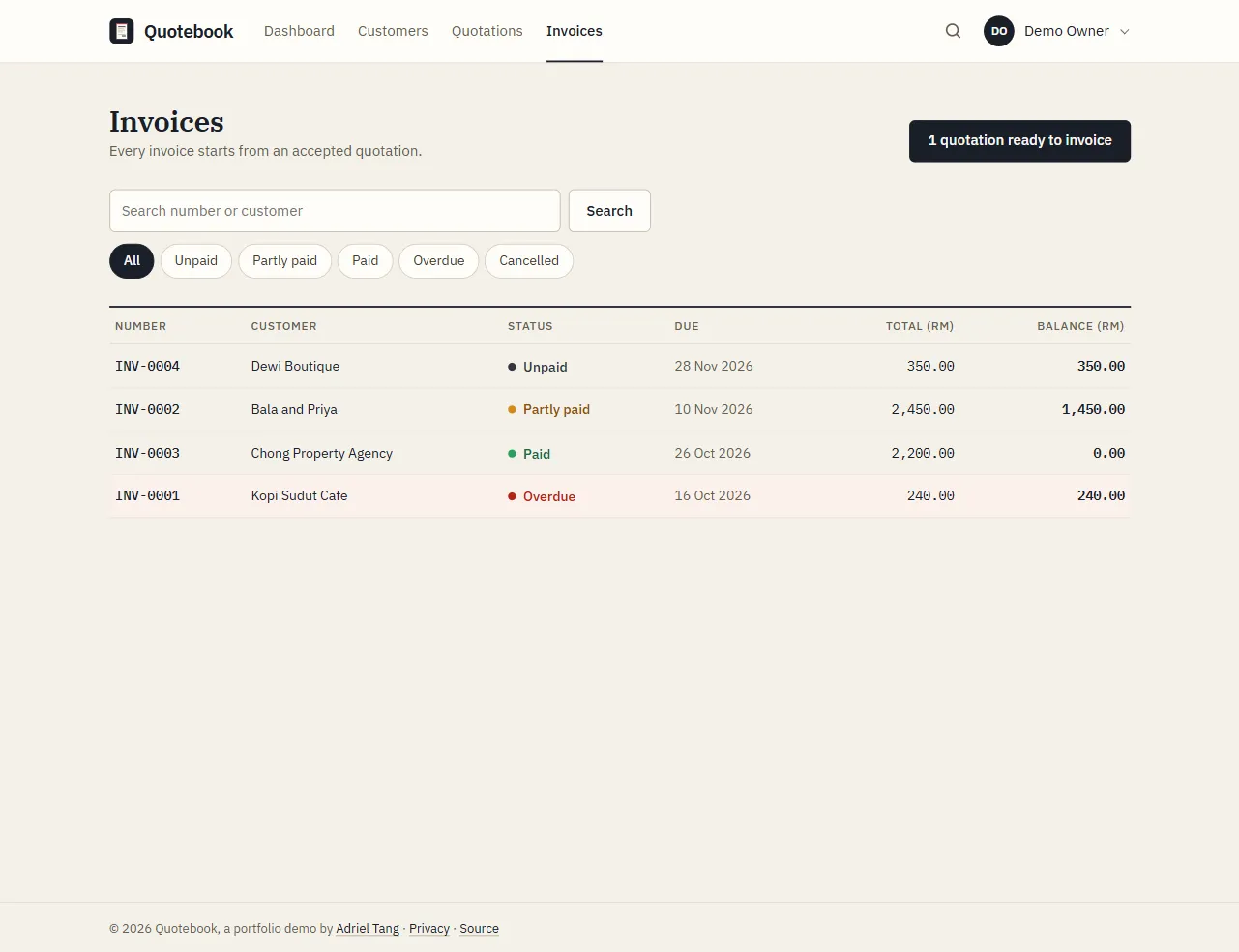
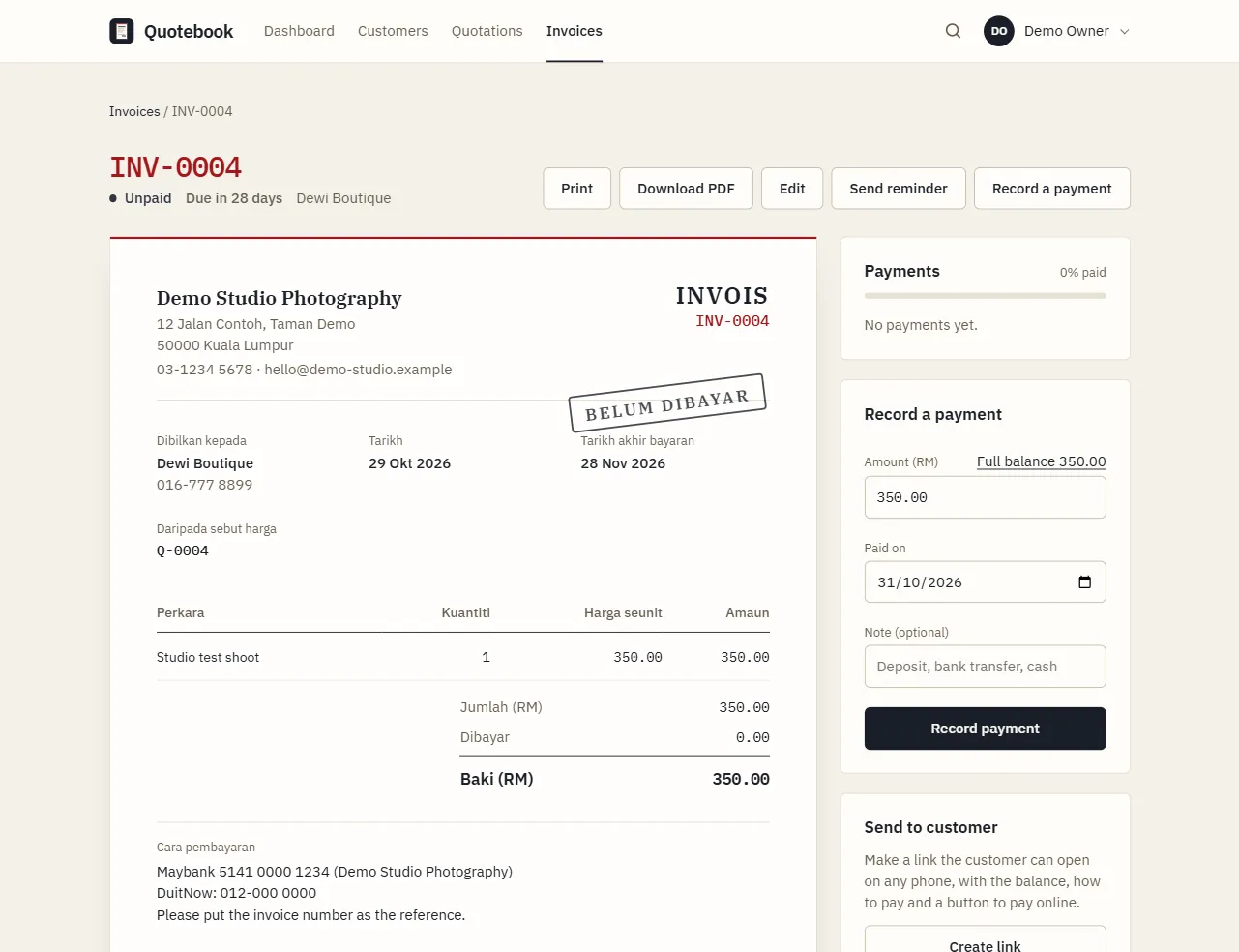
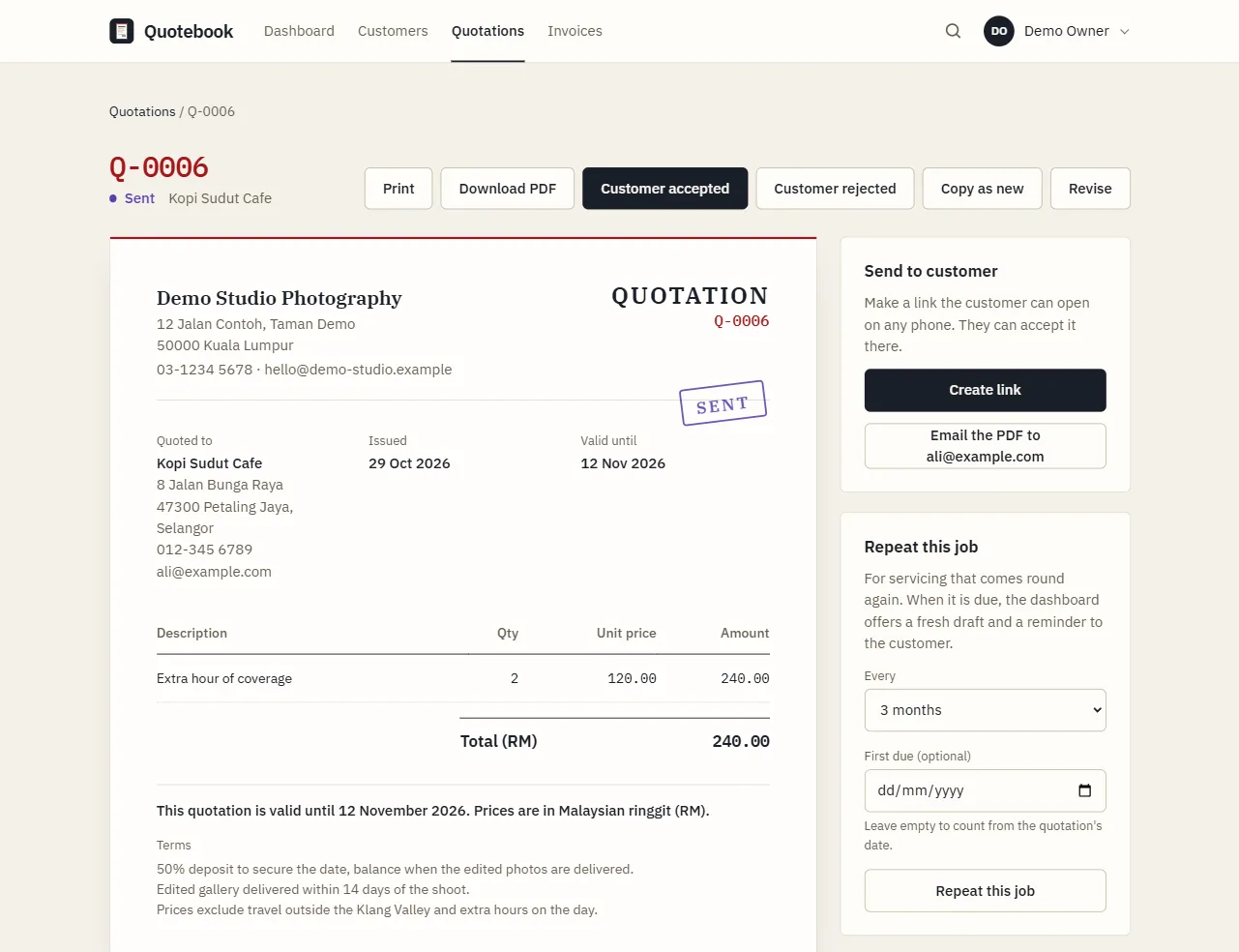
- Status
- Live
- Try the full demo
- No sign-up
- Separate logins
- Owner and staff
- Built for Malaysia
- SST, 5 sen rounding
The problem
What's in it
Press the button on the quote to move the job along
Quote Q-0042
SentAircon servicing, 4 unitsRM 1,200.00
TotalRM 1,200.00
RM 0.00 of RM 1,200.00 paid
Sent to the customer by WhatsApp
Quotebook is a quotation and invoice tracker for small service businesses like photographers, aircon servicers and renovators.
- Quotations and invoices as PDFs, sent by email or WhatsApp, under your own letterhead.
- Your customer opens a link and accepts the quote. No account needed on their side.
- Deposits and instalments, with Unpaid, Partial, Paid or Overdue shown on every invoice.
- Owner and staff logins. Staff see only what they should.
- Built for Malaysia: SST, rounding to 5 sen, credit notes, and English or Bahasa Malaysia per customer.
Mistakes it won't let happen
One business never sees another's customers, quotes or invoices.
Every row carries its business's id, and every query is filtered by it.
A quote becomes one invoice, never two.
The invoice's link to its quote is unique in the database.
An invoice can't show more paid than it's worth, even if two staff record a payment at the same moment.
Invoices carry a version number. The second write is rejected. Details under the hood.
Paid, Partial and Overdue are always up to date.
Status is worked out from the payments each time it's shown, never typed in or stored.
Quote and invoice numbers never repeat, and no empty or negative payment gets recorded.
Numbers are unique per business (each has its own Q-0001 and INV-0001). Payments must be above zero.
What this means for your business
If you run a small service business, like photography, aircon servicing or renovation, this is the kind of system I'd build for you. Quotes your customers accept from a link, invoices made in one click, and one screen that shows who owes you what. Open the demo, then tell me what you'd change for your business.
Under the hood
For developers and anyone hiring: how it's built, and the decisions behind it.
- Role
- Design and build
- Scope
- Web app, 2026
- Stack
- ASP.NET Core, C#, Razor Pages, EF Core, PostgreSQL, QuestPDF, xUnit, Docker
Two staff, one payment, same second
Two people recording the same payment at once can't make an invoice look overpaid.
A payment is a new row, so two people paying at once could both slip past the "not more than owed" check. I force an update on the invoice so the database rejects the second one. I tested it on real PostgreSQL by sending two full payments at the same moment: exactly one was recorded.
Send both payments at the same moment
Payment ARM 600Payment BRM 600
Invoice INV-0042RM 600.00v7
- Payment ARM 600.00Savedv7 → v8
- Payment BRM 600.00Refusedexpected v7, found v8
How it's built
Select a part to see what it does.
- Razor PagesPages and handlers for customers, quotations, invoices and the dashboard.→ Sign-in and roles, Domain rules, EF Core
- Sign-in and rolesASP.NET Identity with Owner and Staff roles, and staff invites by one-time link. The business id travels in the sign-in cookie.→ EF Core
- Domain rulesQuote and invoice rules, payment totals and statuses, with no framework or database code.
- EF CoreThe DbContext, mappings, migrations and the filters that scope every query to one business.→ PostgreSQL
- PostgreSQLThe single source of truth, hosted on Neon. Unique indexes and a check constraint back up the rules.
- xUnit testsCover the domain rules, one business never seeing another's data, and real page flows. They run in their own throwaway schema and refuse to start anywhere else.→ Domain rules, Razor Pages
What broke
- An in-memory test database doesn't enforce foreign keys, so a bug in the quote-to-invoice step only showed on real PostgreSQL. The tests now also run in CI against a throwaway PostgreSQL container.
- Requiring sign-in everywhere also blocked the stylesheets for signed-out visitors, so public pages loaded unstyled. I found it by testing as a visitor, and added a test for it.